
Clean-in-place, usually known as CIP, is one of the most important hygiene systems in a modern food factory. It allows tanks, pipework, valves, fillers, heat exchangers and other product-contact equipment to be cleaned without dismantling the line. Done well, CIP not only reduces factory downtime and manual labour; it also protects food safety, reduces allergen and microbiological risk, improves repeatability and gives production teams confidence that equipment is ready for the next run.
However, CIP can also be a major consumer of water, energy and cleaning chemicals. For companies working towards sustainability targets, that makes CIP a high-impact area: the right system design, equipment specification and operating discipline can reduce environmental footprint while improving hygiene performance.
A typical CIP cycle uses a controlled sequence of pre-rinse, detergent wash, intermediate rinse, acid wash where needed, final rinse and sanitisation. The cleaning effect depends on four core factors: time, temperature, chemical action and mechanical force. If one of these factors is not optimised, the system will have to compensate by over-cleaning, which increases water, steam, electricity and chemical use.
Automated systems can record flow, temperature, chemical concentration through conductivity, cycle duration and any alarms for every clean. This supports traceability and audit readiness by providing evidence that cleaning was completed to validated parameters every time. This evidenced repeatability is a significant benefit of a well-designed and implemented CIP system, especially when dealing with varying allergens, high-fat soils, protein residues, sugars, starches or microbial risks.
Because CIP is generally repeated daily across multiple lines, small improvements can compound into significant savings. A factory that reduces rinse volumes, lowers wash temperatures, recovers or reuses suitable cleaning solutions, or shortens validated cycle times can cut utility consumption without compromising safety. The sustainability opportunity sits in four areas: water, energy, chemicals and waste.
· Water: optimised pre-rinses, recovery tanks and accurate end-point detection reduce unnecessary rinsing.
· Energy: efficient heating, insulation, heat recovery, optimised cycle times and lower-temperature chemistry reduces team and electricity demand.
· Chemicals: controlled dosing, conductivity monitoring and recipe optimisation prevent overuse of caustic, acid and sanitiser.
· Waste: better segregation of first flushes, product recovery and reduced chemical load can lower effluent volume and treatment burden.
The most sustainable CIP system is not necessarily the most common, smallest or cheapest design; it is the system that is correctly matched to the factory’s equipment, products, soils, production schedule and hygiene risks. Oversized systems can waste water and heat, while undersized systems may require longer cycles or repeat cleans. Good design begins with a clear understanding of what is being cleaned, how often, and to what validated standard.
Key design choices include the number and size of tanks, whether solutions are single-use or recovered, the number of circuits that can be cleaned at once, pump sizing, flow velocity, heat source, chemical dosing approach and automation level. Centralised systems may be suitable for large factories with multiple circuits, while compact or mobile systems can be better for lower-frequency cleans, segregated allergen or microbial areas, or specialist equipment.
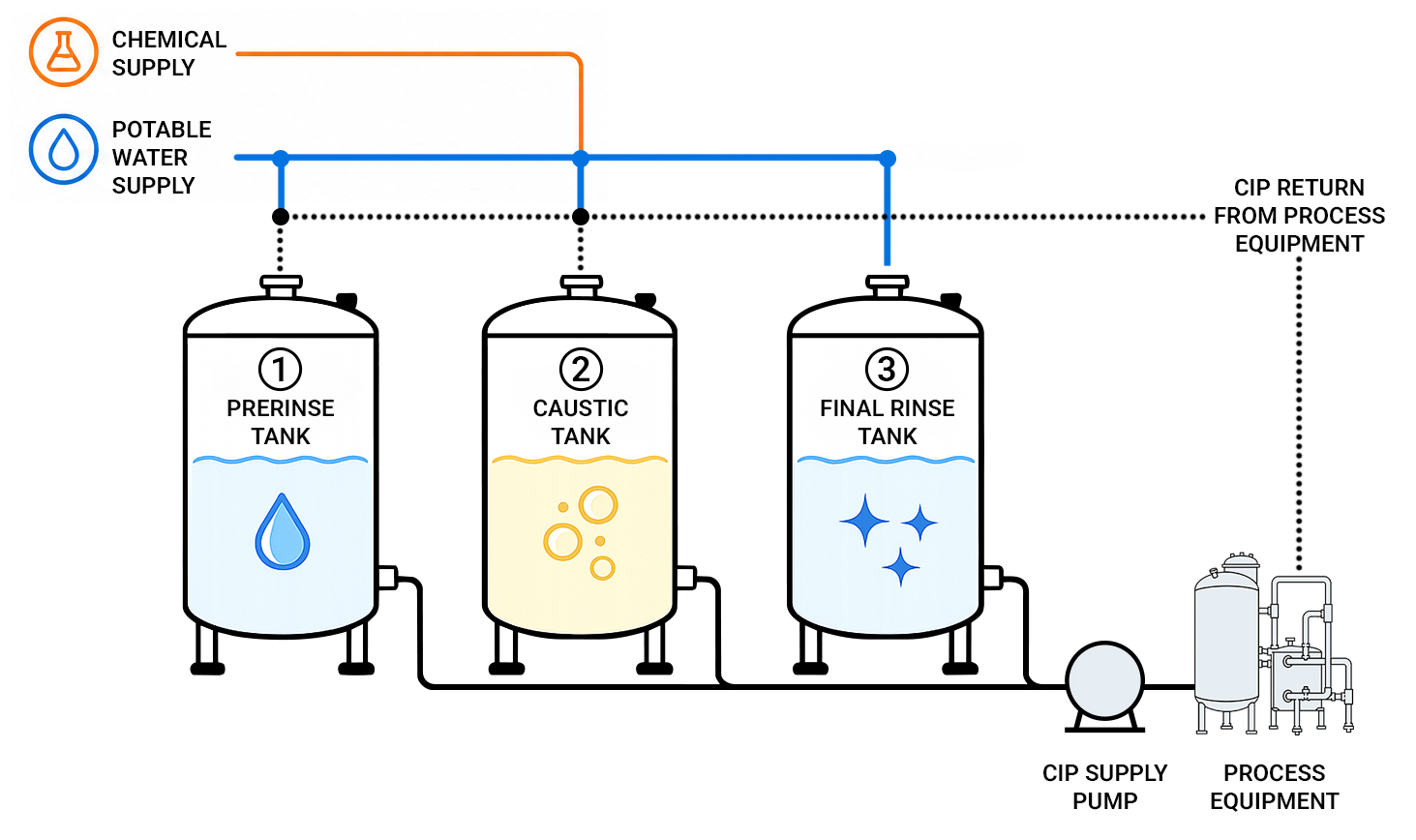
CIP performance depends as much on the equipment being cleaned as on the CIP system itself. In food and beverage factories, manufacturing equipment is often procured from several different specialist suppliers, each with their own approach to cleaning. It is imperative that CIP is considered in the earliest stages of equipment design and procurement to ensure all elements are compatible with the site CIP strategy.
CIP-compatible manufacturing equipment should be hygienically designed with smooth product-contact surfaces, clean welds, suitable materials, accessible seals, hygienic valves, effective spray devices and pipework that drains fully. Avoiding dead legs, minimising unnecessary pipe length and ensuring the right flow path can reduce the amount of rinse water and chemical solution needed to achieve a validated clean. Poorly designed equipment creates dead legs, shadow areas, uncleanable joints, trapped liquid and slow-draining sections, all of which can force longer cleaning cycles and higher resource use.
Manual or time-based CIP can be conservative by design, often running longer than necessary to provide a safety margin. Automation and instrumentation allow cleaning sequences to be designed based on verified conditions rather than assumptions. Flow meters, temperature sensors, conductivity probes, turbidity sensors and chemical dosing controls can confirm that each stage has reached its target before moving to the next step. This allows for a truly optimised process, rather than one based on guesswork and wasteful safety margins.
Data also enables continuous improvement. Long cleans caused by deviations such as low flow, poor return temperature, abnormal chemical use or extended rinse times can be identified and investigated quickly, helping maintenance, hygiene and engineering teams apply practical corrective actions. Changes to CIP trends or CIP alarms can often highlight equipment or maintenance issues before waste is created.
Sustainability improvements must never undermine food safety. Any reduction in time, temperature, chemical concentration or rinse volume should be risk-assessed, validated and verified through microbiological, allergen, visual and chemical residue checks as appropriate. The aim is not simply to clean less; it is to clean more intelligently.
This is where cross-functional ownership matters. Hygiene, technical, engineering, operations, sustainability and procurement teams should work together so that new lines, modifications and cleaning recipes are designed around both validated hygiene and resource efficiency. Supplier selection should also consider hygienic design, cleanability, automation capability and lifecycle resource use, not just capital cost.
Process and product risk
· What products, allergens and soils will each line handle?
· Which areas, lines or circuits require dedicated, segregated or validated cleaning?
System design and resource use
· Can rinse water or cleaning solutions be safely recovered or reused?
· Where are the highest water, energy, chemical and effluent loads likely to occur?
Equipment, layout and supplier integration
· Are all supplier equipment packages compatible with the overall site CIP philosophy, cleaning recipes and validation requirements?
· How will CIP routes, service corridors, drainage, access and segregation influence the factory layout?
· How will maintenance access, drainability and future modifications be considered in the design?
Control, monitoring and validation
· How will flow, temperature, chemical strength, cycle time and alarms be monitored and recorded?
· What evidence will be needed to validate cleaning performance and support audit readiness?
Future flexibility
· How might future product changes, capacity increases or new allergen requirements affect the CIP strategy?
CIP is often viewed as a hygiene necessity, but it should also be treated as a sustainability lever. A well-designed CIP system, paired with hygienically designed equipment and strong process control, can reduce water, energy, chemicals, effluent and downtime while maintaining robust food safety standards.
At Sphere Design, we understand that building a new facility, or modifying an existing one, is not just about the building envelope. To design a facility that can support and enhance all business activities, the first step must be to understand the process. We help food and beverage manufacturers design facilities where hygiene, process efficiency and sustainability are considered from the outset. If you are planning a new facility, modification or CIP upgrade, early design input can help reduce operational costs and support long-term sustainability goals.
By Katie Batty, Design Project Manager at Sphere Design