
In food and beverage manufacturing, efficiency is not created by accident—it is engineered. At the heart of every high-performing facility lies one fundamental principle: design the process first, then build the factory around it. When process flow is optimised from the outset, everything else—layout, utilities, equipment, staffing, and ultimately profitability—falls into place.
Modern manufacturers face an array of pressures: rising costs, complex product portfolios, sustainability demands, and the challenges of outdated equipment and facilities. A strategic approach to process flow efficiency is one of the most effective ways to address these issues while delivering measurable cost savings and long-term resilience.
Why Process Flow Matters
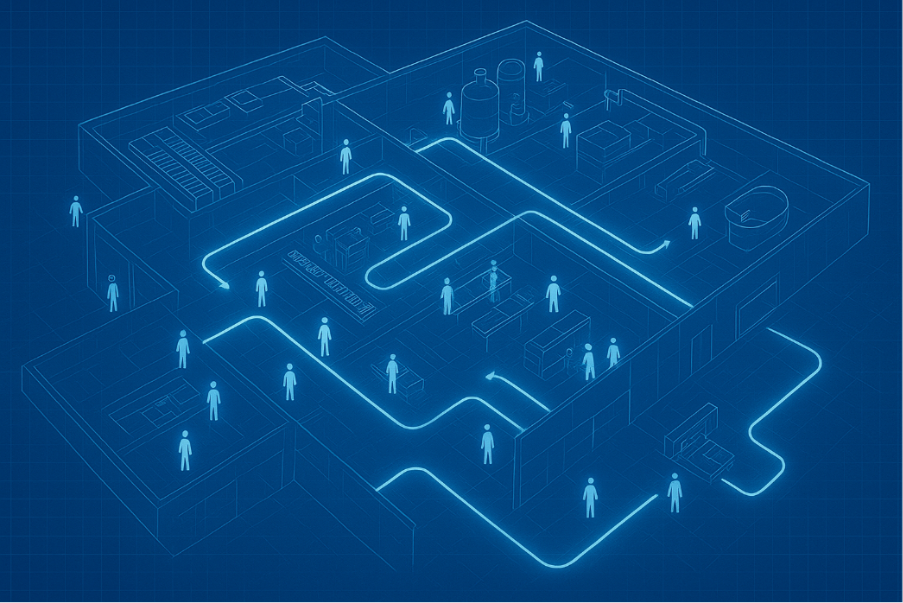
Effective process flow analysis looks beyond the movement of ingredients and products. It considers the entire ecosystem:
People Process
How teams move, interact, and operate within a production environment influence both safety and productivity. Reducing travel distances, minimising manual handling, and improving ergonomic positioning are all essential components of an efficient process design.
Product Process
From raw materials to finished goods, the product journey must be seamless. Bottlenecks, unnecessary steps, and duplicated handling directly add cost. Process definition and process flow optimisation ensure every stage is purposeful, controlled, and aligned with production targets.
Waste Process
Waste isn’t just physical; it can be time, motion, energy, lost opportunity, or most importantly a food safety hazard. Mapping waste streams early through design process allows manufacturers to reduce disposal costs, improve yields, support sustainability goals and ensure safe and effective removal of waste from the hygienic zones.
When these three processes are aligned, production efficiency rises sharply, enabling manufacturers to achieve enhanced productivity and quality.
Strategic Design for Cost-Effective, Future-Proof Solutions
A process-led approach is especially important when planning a new build, upgrade, or refurbishment. Instead of allowing the building footprint or legacy equipment to dictate how operations run, a strategic design approach starts with:
Only then does the facility layout take shape—resulting in a solution that is both cost-effective today and future-proof for tomorrow.
Whether replacing outdated equipment or modernising entire facilities, this method ensures investments are targeted where they deliver maximum long-term value.
From Concept to Detail: Experience-Driven Solutions
Delivering an efficient, high-performing facility requires more than theory. It relies on experience-driven solutions that understand the specific challenges of food and beverage production—from hygiene zoning to allergen control, from temperature-controlled areas to complex utility integration.
Through detailed design workshops, Sphere can translate optimised processes into practical engineering solutions, ensuring the factory layout, services, and technologies work in harmony. The result is a manufacturing environment where:
By starting with process flow and building outward, manufacturers position themselves to deliver measurable cost savings while elevating overall business performance.
Getting the Process Right—Within Your Budget
Every project comes with financial boundaries, and an efficient process doesn’t have to mean a costly redesign. A strategic approach helps manufacturers prioritise investments based on impact,
enabling them to align improvements within available budgets while still achieving meaningful operational gains.
This ensures the right design is achieved for the right cost—balancing immediate needs with long-term scalability.
Conclusion
Process flow efficiency is the cornerstone of a high-performing food and beverage facility. By designing the process first and shaping the factory around it, manufacturers can unlock significant gains in productivity, quality, food safety and profitability.
A strategic, process-led design approach delivers far more than a new layout—it creates a smarter, more resilient manufacturing environment ready to meet both current challenges and future demands.